
Defending Democracy
Explore a tradition of courage, conscience, and leadership in the speeches of African Americans in Congress.
Speech Protesting Actions of the Trump Administration
Sen. Cory Booker
March 31—April 1, 2025
Background
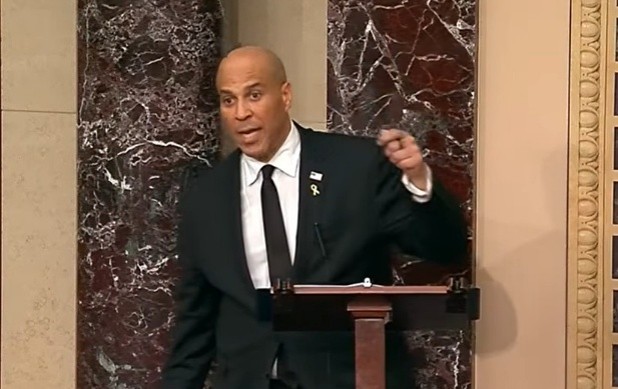
Senator Cory Booker’s (D-NJ) speech on the floor of the U.S. Senate from March 31 to April 1, 2025 stands as the longest individual floor speech in Senate history. Beginning at 7 p.m. and continuing for 25 hours and 5 minutes, the marathon address protested what Sen. Booker called a crisis of democratic governance during the second presidency of Donald Trump. “I rise with the intention of disrupting the normal business of the United States Senate for as long as I am physically able. I rise tonight because I believe sincerely that our country is in crisis,” Sen. Booker explained during his introductory remarks. “The threats to American people and American democracy are grave and urgent, and we all must do more to stand against them.”
Sen. Booker took to the Senate floor just over two months into President Trump’s second term, a period in which the administration moved quickly on sweeping policy changes. Through a flurry of executive orders and actions, the Trump administration conducted mass layoffs of federal workers, proposed deep cuts to Social Security and Medicare, pushed to eliminate the Department of Education, and ignited debates over immigration, foreign policy, and many other issues. Sen. Booker addressed these and other topics in his wide-ranging speech, highlighting what he saw as the administration’s disregard for the rule of law, the Constitution, and the needs of the American people. He shared letters from constituents, statements from experts, and his own personal experiences to challenge the nation to work together to address what he saw as a “moral moment” rather than a partisan one.
Hundreds of thousands of viewers watched on television and internet livestreams as Sen. Booker, New Jersey’s first African American senator, broke the previous record for longest floor speech set by Senator Strom Thurmond (R-SC), a segregationist who filibustered for 24 hours and 18 minutes in an effort to prevent the passage of the Civil Rights Act of 1957. When Sen. Booker finally yielded the floor on the evening of April 1, 2025, those gathered in the chamber to witness the moment gave him a standing ovation.
The speech was more than a theatrical feat of endurance. At its core, Sen. Booker’s address was a call for Congress to fulfill its constitutional duty to act as a check on executive power and for Americans more broadly to stand against injustice. He reminded the nation that democracy depends not only on strong institutions, but also on the willingness of leaders and citizens to do the hard work necessary to uphold them. In transforming a record once held by a defender of segregation into a statement of democratic ideals, Sen. Booker took his place in a long tradition of African American lawmakers who have used the floor of Congress to defend the principles of American democracy at its most critical moments.
C-SPAN
Opening Remarks of Speech Protesting Actions of the Trump Administration
Senator Cory Booker (D-NJ)
March 31—April 1, 2025
United States Senate Chamber, United States Capitol, Washington, DC
Below are excerpts of Sen. Booker’s speech with selected video and citations from the Congressional Record. Full speech video.
Speech in the Congressional Record
- Part 1 – 119th Cong. 1st Sess. Congressional Record 171, No. 57: S1931-S1959.
- Part 2 – 119th Cong. 1st Sess. Congressional Record 171, No. 57 – Part II: S1961-S2034.
- Part 3 – 119th Cong. 1st Sess. Congressional Record 171, No. 57 – Part II: S2034-2084.
Introduction and Motivation for Speaking – 119th Cong. 1st Sess. Congressional Record 171, No. 57: S1931-S1933.
I am really grateful Mr. President, grateful you’re in the Chair and I’m grateful to be able to rise right now and speak.
I want to say at the top that I have a tremendous love for this institution, and a lot of that’s born from the people that are here—from the pages I get to know in every class, to the folks that work the doors, the clerks, the Parliamentarians. This is a special place, and a lot of the people who are known here are not the ones who really keep this place functioning.
I come in here days and I have good moods or bad moods but always find myself lifted when I walk onto this floor. It’s a sacred civic space. It is extraordinary. And I’m always aware of the weight of history when I walk in here. No matter good day, bad day, whether I’m in a rush or not, when I touch the Senate floor, I feel something really magnificent.
I don’t think that our Founders would’ve ever imagined a body like this with Black people on both sides of the aisle, with women serving here, with folks from many different backgrounds. We are in many ways doing what the Founders had envisioned, which was this idea of every generation making this a more perfect Union.
But there have been times in this journey where our Union was in crisis and was in peril. There have been times in this great American journey, over our 250 years, where so many heroes had to emerge, people that I’ve come to revere, like Joshua Chamberlain from Maine, who played such a pivotal role in the Battle of Gettysburg. What a noble soul he was. He would later go on to be the Governor of his State and go on to great things, but his heroism lay that in a time of crisis, he stood up.
I know there are veterans in this body—I admire them so much—who have answered that call to serve our country and put their lives at sacrifice.
There are people that I admire that are heroes of mine that were suffragettes. There were people who fought as abolitionists. There are people more recently that I’ve come to lionize and admire because they did so much for this country—not with titles, not with high rank or positions, but folks who, when this country was facing crossroads, was facing crises, they stood up. They spoke up.
One of my greatest heroes of life was a man I got to serve with named John Lewis. And I served with him while in this body and every opportunity I had, I would ask him about the times when he was just a 20-something. He was the youngest person who was a feature speaker on the March on Washington. He was called the bravest man in the civil rights movement because he kept putting himself in harm’s way to dramatize, to let folks know, to bring attention to the injustices in this world and to say very strongly that this—what was going on in our country—is not normal, that what is going on in our country is wrong.
I stand on this floor as a U.S. Senator, but I revere people who never stood on this floor; people who, before they even got to their thirties and forties and fifties in life, were out there as great patriots fighting for this Nation.
I rise today in an unusual manner, and I want to be clear and explain that. But I just want to tell you what John Lewis said. It’s a quote so many people know. He really spoke not to Members of the Senate or the Congress; he was really speaking to Americans. He said: “Get in good trouble, necessary trouble, help redeem the soul of America.”
John Lewis died in 2020, in July, at a time that—it was Donald Trump’s first term in office and he did what Congress people did, but he also did some really extraordinary things to fight for healthcare.
My friend Chris Murphy knows about that. He was there when John Lewis did an open Facebook chat—not in this Chamber or the House Chamber; he sat on the steps, and people were there. I remember when he did a sit-in. They had to shut the cameras off on him. He got in good trouble on the House side too.
And so I start tonight thinking about him. I’ve been thinking about him a lot during these last 71 days— “Get in good trouble, necessary trouble, and help redeem the soul of America,” and I had to ask myself, if he’s my hero, how am I living up to his words?
I think Democrats and Republicans have made a lot of mistakes. No side has a monopoly on the truth. No side has been perfect servants of this country. But what’s happened in the last 71 days is a patent demonstration of a time where John Lewis’s call to everyone has, I think, become more urgent and more pressing. and if I think it’s a call for our country, I have to ask myself how I’m living these words?
So tonight, I rise with the intention of getting in some good trouble. I rise with the intention of disrupting the normal business of the United States Senate for as long as I am physically able. I rise tonight because I believe sincerely that our country is in crisis. And I believe that not in a partisan sense because so many of the people that have been reaching out to my office in pain, in fear, having their lives upended—so many of them identify themselves as Republicans. Indeed, in conversations from in this body, to in this building, to across my State, and recently in a travel across the country, Republicans as well as Democrats are talking to me about what they feel is a sense of dread about a growing crisis or what they point to about what is going wrong.
The bedrock commitments in our country that both sides rely on—that people from all backgrounds rely on—those bedrock commitments are being broken. Unnecessary hardships are being born by Americans of all backgrounds. And Institutions which are special in America, which are precious, which are unique in our country, are being recklessly—and I would say even unconstitutionally—affected, attacked, even shattered.
In just 71 days, the President of the United States has inflicted so much harm on Americans’ safety, financial stability, the core foundations of our democracy, and even our aspirations as a people from our highest offices, a sense of common decency. These are not normal times in America, and they should not be treated as such.
John Lewis and so many heroes before us would say that this is the time to stand up, to speak up. This is the time to get in some good trouble, to get into necessary trouble.
I can’t allow this body to continue without doing something different, speaking out. The threats to American people and American democracy are grave and urgent, and we all must do more. We all must do more against them.
But those 10 words—“If it is to be, it is up to me”—all of us have to think of those 10 words, those 10 two-letter words—“If it is to be, it is up to me”—because I believe generations from now will look back at this moment and have a single question: Where were you? Where were you when our country was in crisis and when American people were asking for help: Help me. Help me. Did we speak up?
When 73 million American seniors who rely on Social Security were to have that promise mocked, attacked, and then to have the services undermined, to be told “There will be no one there to answer if you call for help”; when our seniors became afraid and worried and panicked because of the menacing words of their President, of the most wealthy person in the world, of Cabinet Secretaries. Did we speak up?
When the American economy in 71 days—71 days—has been upended; when prices at the grocery store were skyrocketing and the stock market was plunging; when pension funds, 401(k)s were going down; when Americans were hurting and looking up; when the resounding answer to this question was no—are you better off economically than you were 71 days ago?
Where were you? Did you speak up at a time when the President of the United States was launching trade wars against our most close allies, when he was firing regulators who investigate America’s biggest banks and biggest corporations to stop them from taking advantage of the little guy or the little gal or my grandmother or your grandfather, dismantling the Agency that protects consumers from fraud—the only one whose sole purpose is to look out for them?
Did you just speak up when the President of the United States, in a way that is so crass and craven, peddled his own meme coin and made millions upon millions of dollars for his own bank account at a time so many are struggling economically?
Did you speak up when the President of the United States did what amounts to a car commercial for the richest man in the world right in front of America’s house, the White House?
When the president tried to take healthcare away, where were you? Did you speak up? Threatening a program called Medicaid, helps people with disabilities, helps expectant mothers, helps millions upon millions of Americans. And why? Why? As a part of a larger plan to pay for tax cuts for the wealthiest amongst us who’ve done the best over the last 20 years, for billionaires that seem so close to the President that they sat right on the dais at his inauguration and sit in his Cabinet meetings at the White House.
Did you speak up when he gutted public education, slashed funds for pediatric cancer research, fired thousands of veterans who risked their lives for their country; when he abandoned our allies and our international commitments at a time when floods, fires, hurricanes, and droughts are devastating communities across this country; when countries all around the world a banding together to do something and he turned his back?
Did you speak up when outbreaks of dangerous, infectious diseases are still a global threat, yet we have stopped engaging in the efforts necessary to meet those threats?
Where were you when the American press was being censored; when international students were being disappeared from American streets without due process; when American universities were being intimidated into silence, challenging that fundamental idea of freedom of thought, freedom of expression; when the law firms that represent clients that may not be favored are attacked and attacked and attacked? Where were you? Did you speak up when they came for those firms?
What about when the people who attacked the police officers who defended this building—an American democracy—on January 6; who just outside those doors put their lives on the line for us, and many of them would later die—where were you when the President pardoned them, celebrated them, and even talked of giving them money, people who savagely beat American police officers?
Did you speak up when Americans from across the country were all speaking up, when more and more voices in this country were speaking up saying; “This is not right. This is un-American. This is not who we are. This is not America”? Did you speak up?
And so I rise tonight because I believe to be about what is normal right now when so much abnormal is happening is unacceptable. I rise tonight because silence at this moment of national crisis would be a betrayal of some of the greatest heroes of our Nation, because at stake in this moment is nothing less than everything that we brag about, that we talk about, that makes us special.
At stake right now are some of our most basic American principles that so many Americans understand are worth fighting for, worth standing for, worth speaking up for—like, if you work hard your entire life and pay into Social Security, it should be there for you when you retire, and you should not have to question if those paychecks will arrive and the government should strive to improve service to you, not brag about cutting it; basic American principles like, if you serve your Nation in the military, if you put your life in danger abroad, you will be respected and taken care of. You will be cherished and honored and not forced to worry that the Federal employees who provide you with care, many of whom who are veterans themselves, will be fired or the benefits that you rely on will be denied or that your healthcare needs won’t be met; basic American principles like your child will have access to a high-quality public education that every child has a unique genius, even our children—beautiful children—with special needs; they have genius; and that our children can go to school and parents and teachers know that they will be safe there.
At stake now are those basic American principles; that the people you elect to serve you in government will represent you and not try to make themselves richer, not run some scam, and call you a sucker; the basic ideals of our Nation that everyone’s rights will be equally protected, and everyone will be held accountable under the law. Right now, all of this—things that make our country different—are under attack. Our constituents are asking us to acknowledge this. Everywhere I travel now, I hear from Republicans and Independents and Democrats who are afraid, who are worried, who are angry.
I think about John Lewis, who taught me that fear is not something to be shunned. It’s almost a signpost that you’re headed in the right direction. It is something that is a necessary precondition. You cannot have great fear without great courage. John Lewis would tell us that this is a time for great courage. He would tell us that anger is a fuel. It can consume you, debilitate you, or it could fuel you to put yourself in service of others. I feel, if my friend was here, if my hero was here, he would tell us and try to teach us that this is a moment to know that despair is only possible if you don’t meet it as an agent of hope.
If John Lewis was here, he would look at me and say: What are you doing? What are we doing?
So, tonight I rise in an unusual way. I rise with the intention to stand here until I can stand no longer, until I’m physically unable to stand anymore. I’m going to speak up. I’m going to try to cause some good trouble in this body I respect so much. I’m going to try to cause what I believe is necessary trouble. I’m going to try to honor the legacy that I know I’ve inherited as an American, the legacy I think about when I come to this floor and feel sometimes overwhelmed with all the sacrifice and struggle that had to get me here; good people who caused good trouble in the face of slavery; good people who caused good trouble in the face of the denial of the right to vote; good people who caused good trouble in the cause of equal rights; good people who caused good trouble in the fight against hate; good people who caused good trouble in the fight against demagogues from McCarthyism to Father Coughlin, to big people who showed such small character when they tried to suppress others. I want to cause good trouble and prove worthy of those who came before.
This is not normal. Listen to America. Listen to Americans. They seem to always be ahead of this body. They’re rising up in State after State, not along partisan lines, but as an American line. Not because they hate other Americans, but because they love America. And Know, what does love look like in public? It looks like justice, and there is so much injustice going on.
I don’t know how long I can stand, but I will stand and speak up.
Senator Booker continued to hold the floor for a total of 25 hours and 5 minutes, breaking the record for the longest floor speech in history. During this time, Sen. Booker cited stories from constituents, reflected on his own personal experiences, and yielded for questions from Democratic colleagues. The wide-ranging speech covered many topics including Social Security, Medicaid, education, immigration, national security, foreign policy, housing affordability, environmental policy, and agriculture before Sen. Booker offered the concluding words on the evening of April 1, 2025. Explore the full speech.
C-SPAN
Concluding Remarks of Speech Protesting Actions of the Trump Administration
119th Cong. 1st Sess. Congressional Record 171, No. 57 – Part III: S2083-2084.
The power of the people is greater than the people in power.
It is time to heed the words of the man I began this whole thing with, John Lewis. I beg folks to take his example of his early days, where he made himself determined to show his love for his country at a time the country didn’t love him, to love this country so much, to be such a patriot that he endured beatings savagely on the Edmund Pettus Bridge, at lunch counters, on Freedom Rides.
He said he had to do something. He would not normalize a moment like this. He would not just go along with business as usual. He wouldn’t know how to solve it.
But there’s one thing that he would do that I hope we all can do, that I think I did a little bit of tonight. He said for us to go out and cause some good trouble, necessary trouble, to redeem the soul of our Nation.
I want you to redeem the dream. Let’s be bold in America, not demean and degrade Americans, not divide us against each other. Let’s be bolder in America, with a vision that inspires with hope, that starts with the people of the United States of America.
That’s how this country started, we the people. Let’s get back to the ideals that others are threatening. Let’s get back to our Founding documents that those imperfect geniuses had some very special words at the end of the Declaration of Independence. [It] was one of the greatest in all of humanity, the Declarations of Interdependence, when our Founders said, we must mutually pledge, pledge to each other, our lives, our fortunes and our sacred honor. We need that now from all Americans.
This is a moral moment. It’s not left or right, it’s right or wrong. Let’s get in good trouble.
My friend, Madam President, I yield the floor.
At the time of Sen. Booker’s speech, 66 African Americans served in the 119th Congress (61 in the House and 5 in the Senate) with members belonging to both the Democratic and Republican Parties.
At the Time of Sen. Booker’s speech, 155 women served in the 119th Congress. Of those, 29 were African American women. More from Avoice on African American women in Congress.
Rep. John Lewis (D-GA) spoke about his early participation in the civil rights moment as part of the Avoice in Action series.
Rep. John Lewis and Sen. Cory Booker began a Facebook Live chat on the steps of the U.S. Capitol around 7pm on June 27, 2017 to discuss healthcare and Republican attempts to repeal the Affordable Care Act. Over the few hours they were joined by other Democratic lawmakers and hundreds of others. Thousands more watched online via social media.
On June 22, 2016, Representative John Lewis (D-GA) and other members of the House Democratic Caucus held a sit-in on the House Floor to call for votes on gun control legislation following the Pulse nightclub shooting in Orlando, FL. Speaker pro tempore, Sen. Dan Webster (R-FL), ended video coverage of their efforts by ordering the House into recess.
Sen. Booker began his speech 71 days after President Donald J. Trump was sworn in for his second, nonconsecutive term as President of the United States on January 20, 2025.