
Defending Democracy
Explore a tradition of courage, conscience, and leadership in the speeches of African Americans in Congress.
Farewell to Congress [Defense of the Negro Race—Charges Answered]
Rep. George H. White
January 29, 1901
Background
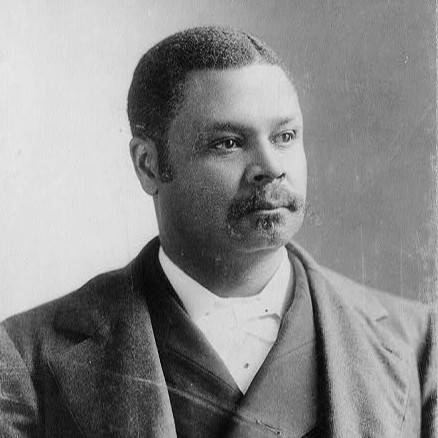
On January 29, 1901, Congressman George H. White (R-NC) rose to speak on the floor of the U.S. House of Representatives for the final time. When he stepped down, no African American would remain in Congress. A tireless advocate for Black civil and political rights throughout his time in office, Rep. White used his final speech to deliver an impassioned defense of Black Americans and a call for the nation to uphold the promises written into its Constitution.
Rep. White’s speech followed one of the most dramatic reversals in the history of American democracy. In the decades following the Civil War, new constitutional amendments and civil rights laws opened the door for twenty-two African American men to serve in Congress. By the turn of the century, however, violence and a campaign by white supremacists to pass disfranchisement laws and rewrite state constitutions had stripped Black Southerners of those gains and left Rep. White the sole African American serving in Congress.
After he was blocked from speaking at length during debate on an amendment to reduce congressional representation for Southern states disenfranchising voters, Rep. White seized another opportunity. He took the floor during debate on an agricultural appropriations bill to deliver what he called “a plea for the colored man, the colored woman, the colored boy, and the colored girl of this country.”
In his speech, Rep. White demanded Congress honor the promises made to Black Americans in the Constitution and federal law. He named the methods used across the South to erase Black political participation, from disfranchising laws to “cold-blooded fraud and intimidation.” He reminded his colleagues that the Fourteenth Amendment required states that disenfranchised voters to lose seats in Congress, a provision they were sworn to uphold yet did nothing to enforce. He also confronted members of Congress who used the alleged misconduct of individual Black Americans to justify stripping rights from all of them. Beyond voting rights, Rep. White called out Congress’s failure to pass antilynching legislation or to address unresolved claims of Freedmen’s Savings and Trust Company depositors after the government-backed bank failed.
Rep. White closed not in defeat but in faith. His departure, he insisted, was only a temporary setback in the struggle to make America’s democratic ideals real. “Phoenix-like,” Rep. White predicted, African Americans “will rise up some day and come again.” He was right, though it would be twenty-eight years before another African American entered Congress and North Carolina would not elect another Black representative until 1992.
In refusing to leave Congress quietly, Rep. White indicted the nation’s failures even as he trusted in its eventual reckoning. His speech stands as part of the long tradition of African American members who have used the floor of Congress to confront injustice and hold the nation to its founding ideals, a tradition that continues today as challenges to voting rights again reshape representation in Congress.
Farewell to Congress [Defense of the Negro Race—Charges Answered]
Representative George H. White (R-NC)
January 29, 1901
Abridged below from the Congressional Record, 56th Cong., 2d Sess., (29 January 1901): 1634-8. Full text.
Mr. Chairman, in the consideration of the bill now under debate the Committee on Agriculture has had a wide and very varied experience…
But, Mr. Chairman, there are others on this committee and in this House who are far better prepared to enlighten the world with their eloquence as to what the agriculturists of this country need than your humble servant. I therefore resign to more competent minds the discussion of this bill. I shall consume the remainder of my time in reverting to measures and facts that have in them more weighty interests to me and mine than that of agriculture–matters of life and existence.
I want to enter a plea for the colored man, the colored woman, the colored boy, and the colored girl of this country. I would not thus digress from the question at issue and detain the House in a discussion of the interests of this particular people at this time but for the constant and the persistent efforts of certain gentlemen upon this floor to mold and rivet public sentiment against us as a people and to lose no opportunity to hold up the unfortunate few who commit crimes and depredations and lead lives of infamy and shame, as other races do, as fair specimens of representatives of the entire colored race. And at no time, perhaps, during the Fifty-sixth Congress were these charges and countercharges, containing, as they do, slanderous statements, more persistently magnified and pressed upon the attention of the nation than during the consideration of the recent reapportionment bill, which is now a law. As stated some days ago on this floor by me, I then sought diligently to obtain an opportunity to answer some of the statements made by gentlemen from different States, but the privilege was denied me; and I therefore must embrace this opportunity to say, out of season, perhaps, that which I was not permitted to say in season.
In the catalogue of members of Congress in this House perhaps none have been more persistent in their determination to bring the black man into disrepute and, with a labored effort, to show that he was unworthy of the right of citizenship than my colleague from North Carolina, Mr. [William Walton] Kitchin. During the first session of this Congress, while the Constitutional amendment was pending in North Carolina, he labored long and hard to show that the white race was at all times and under all circumstances superior to the negro by inheritance if not otherwise, and the excuse for his party supporting that amendment, which has since been adopted, was that an illiterate negro was unfit to participate in making the laws of a sovereign State and the administration and execution of them; but an illiterate white man living by his side, with no more or perhaps not as much property, with no more exalted character, no higher thoughts of civilization, no more knowledge of the handicraft of government, had by birth, because he was white, inherited some peculiar qualification, clear, I presume, only in the mind of the gentleman who endeavored to impress it upon others, that entitled him to vote, though he knew nothing whatever of letters. It is true, in my opinion, that men brood over things at times which they would have exist until they fool themselves and actually, sometimes honestly, believe that such things do exist.
I would like to call the gentleman’s attention to the fact that the Constitution of the United States forbids the granting of any title of nobility to any citizen thereof, and while it does not in letters forbid the inheritance of this superior caste, I believe in the fertile imagination of the gentleman promulgating it, his position is at least in conflict with the spirit of that organic law of the land. He insists and, I believe, has introduced a resolution in this House for the repeal of the fifteenth amendment to the Constitution. As an excuse for his peculiar notions about the exercise of the right of franchise by citizens of the United States of different nationality, perhaps it would not be amiss to call the attention of this House to a few facts and figures surrounding his birth and rearing. To begin with, he was born in one of the counties in my district, Halifax, a rather significant name.
I might state as a further general fact that the Democrats of North Carolina got possession of the State and local government since my last election in 1898, and that I bid adieu to these historic walls on the 4th day of next March, and that the brother of Mr. Kitchin will succeed me. Comment is unnecessary. In the town where this young gentleman was born, at the general election last August for the adoption of the constitutional amendment, and the general election for State and county officers, Scotland Neck had a registered white vote of 395, most of whom of course were Democrats, and a registered colored vote of 534, virtually if not all of whom were Republicans, and so voted. When the count was announced, however, there were 831 Democrats to 75 Republicans; but in the town of Halifax, same county, the result was much more pronounced.
In that town the registered Republican vote was 345, and the total registered vote of the township was 539, but when the count was announced it stood 990 Democrats to 41 Republicans, or 492 more Democratic votes counted than were registered votes in the township. Comment here is unnecessary, nor do I think it necessary for anyone to wonder at the peculiar notion my colleague has with reference to the manner of voting and the method of counting those votes, nor is it to be a wonder that he is a member of this Congress, having been brought up and educated in such wonderful notions of dealing out fair-handed justice to his fellow-man.
It would be unfair, however, for me to leave the inference upon the minds of those who hear me that all of the white people of the State of North Carolina hold views with Mr. Kitchin and think as he does. Thank God there are many noble exceptions to the example he sets, that, too, in the Democratic party; men who have never been afraid that one uneducated, poor, depressed negro could put to flight and chase into degredation two educated, wealthy, thrifty white men. There never has been, nor ever will be, any negro domination in that State, and no one knows it any better than the Democratic party. It is a convenient howl, however, often resorted to in order to consummate a diabolical purpose by scaring the weak and gullible whites into support of measures and men suitable to the demagogue and the ambitious office seeker, whose crave for office overshadows and puts to flight all other considerations, fair or unfair…
It is an undisputed fact that the negro vote in the State of Alabama, as well as most Southern States, have been effectively suppressed, either one way or the other–in some instances by constitutional amendment and State legislation, in others by cold-blooded fraud and intimidation, but whatever the method pursued, it is not denied, but frankly admitted in the speeches in this House, that the black vote has been eliminated to a large extent. Then, when some of us insist that the plain letter of the Constitution of the United States, which all of us have sworn to support, should be carried out, as expressed in the second section of the fourteenth amendment thereof, to wit:
Representatives shall be apportioned among the several States according to their respective numbers, counting the whole number of persons in each State, excluding Indians not taxed. But when the right to vote at any election for the choice of electors for President and Vice-President of the United States, Representatives in Congress, the executive and judicial officers of a State, or the members of a legislature thereof, is denied to any of the male inhabitants of such State, being twenty-one years of age, and citizens of the United States, or in any way abridged, except for participation in rebellion, or other crime, the basis of representation therein shall be reduced in proportion which the number of such male citizens shall bear to the whole number of male citizens twenty-one years of age in such State.
That section makes the duty of every member of Congress plain, and yet the gentleman from Alabama [Oscar Wilder Underwood] says that the attempt to enforce this section of the organic law is the throwing down of firebrands, and notifies the world that this attempt to execute the highest law of the land will be retaliated by the South, and the inference is that the negro will be even more severely punished than the horrors through which he has already come.
Let me make it plain: The divine law, as well as most of the State laws, says, in substance: “He that sheddeth man’s blood, by man shall his blood be shed.” A highwayman commits murder and when the officers of the law undertake to arrest, try, and punish him commensurate with the enormity of his crime, he straightens himself up to his full height and defiantly says to them: “Let me alone; I will not be arrested, I will not be tried, I’ll have none of the execution of your laws, and in the event you attempt to execute your laws upon me, I will see to it that many more men, women, or children are murdered.”
Here’s the plain letter of the Constitution, the plain, simple, sworn duty of every member of Congress; yet these gentlemen from the South say “Yes, we have violated your Constitution of the nation; we regarded it as a local necessity; and now, if you undertake to punish us as the Constitution prescribes, we will see to it that our former deeds of disloyalty to that instrument, our former acts of disfranchisement and opposition to the highest law of the land will be repeated many fold.”
Not content with all that has been done to the black man, not because of any deeds that he has done, Mr. Underwood advances the startling information that these people have been thrust upon the whites of the South, forgetting, perhaps, the horrors of the slave trade, the unspeakable horrors of the transit from the shores of Africa by means of the middle passage to the American clime; the enforced bondage of the blacks and their descendants for two and a half centuries in the United States, now, for the first time perhaps in the history of our lives, the information comes that these poor, helpless, and in the main inoffensive people were thrust upon our Southern brethren.
Individually, and so far as my race is concerned, I care but little about the reduction of Southern representation, except in so far as it becomes my duty to aid in the proper execution of all the laws of the land in whatever sphere in which I may be placed. Such reduction in representation, it is true, would make more secure the installment of the great Republican party in power for many years to come in all of its branches, and at the same time enable that great party to be able to dispense with the further support of the loyal negro vote; and I might here parenthetically state that there are some members of the Republican party to-day—“lily whites,” if you please—who, after receiving the unalloyed support of the negro vote for over thirty years, now feel that they have grown a little too good for association with him politically, and are disposed to dump him overboard. I am glad to observe, however, that this class constitutes a very small percentage of those to whom we have always looked for friendship and protection.
I wish to quote from another Southern gentleman, not so young as my other friends, and who always commands attention in this House by his wit and humor, even though his speeches may not be edifying and instructive. I refer to Mr. [Peter Johnston] Otey, of Virginia, and quote from him in a recent speech on this floor, as follows:
Justice is merely relative. It can exist between equals. It can exist among homogeneous people. Among equals—among heterogeneous people—it never has and, in the very natures of things, it never will obtain. It can exist among lions, but between lions and lambs, never. If justice were absolute, lions must of necessity perish. Open his ponderous jaws and find the strong teeth which God has made expressly to chew lamb’s flesh! When the Society for the Prevention of Cruelty to Animals shall overcome this difficulty, men may hope to settle the race question along sentimental lines, not sooner.
These thoughts on the negro are from the pen, in the main, of one who has studied the negro question, and it was after I heard the gentleman from North Carolina, and after the introduction of the Crumpacker bill, that they occurred to me peculiarly appropriate.
I am wholly at sea as to just what Mr. Otey had in view in advancing the thoughts contained in the above quotation, unless he wishes to extend the simile and apply the lion as a white man and the negro as a lamb. In that case we will gladly accept the comparison, for of all animals known in God’s creation the lamb is the most inoffensive, and has been in all ages held up as a badge of innocence. But what will my good friend of Virginia do with the Bible, for God says that He created all men of one flesh and blood? Again, we insist on having one race—the lion clothed with great strength, vicious, and with destructive propensities, while the other is weak, good natured, inoffensive, and useful—what will he do with the pure lion to the pure lamb, found on the plantations of every Southern State in the Union?
I regard his borrowed thoughts, as he admits they are, as very inaptly applied. However, it has perhaps served the purpose for which he intended it—the attempt to show the inferiority of the one and the superiority of the other. I fear I am giving too much time in the consideration of these personal comments of members of Congress, but I trust I will be pardoned for making a passing reference to one more gentleman—Mr. [Stanyarne] Wilson of South Carolina—who, in the early part of this month, made a speech some parts of which did great credit to him, showing, as it did, capacity for collating, arranging, and advancing thoughts of others and of making a pretty strong argument out of a very poor case.
If he had stopped there, while not agreeing with him, many of us would have been forced to admit that he had done well. But his purpose was incomplete until he dragged in the reconstruction days and held up to scorn and ridicule the few ignorant, gullible, and perhaps purchasable negroes who served in the State legislature of South Carolina over thirty years ago. Not a word did he say about the unscrupulous white men, in the main bummers who followed in the wake of the Federal Army and settled themselves in the Southern States, and preyed upon the ignorant and unskilled minds of the colored people, looted the States of their wealth, brought into lowest disrepute the ignorant colored people, then hied away to their Northern homes for ease and comfort the balance of their lives, or joined the Democratic party to obtain social recognition, and have greatly aided in depressing and further degrading those whom they had used as easy tools to accomplish a diabolical purpose.
These few ignorant men who chanced at that time to hold office are given as a reason why the black man should not be permitted to participate in the affairs of the Government which he is forced to pay taxes to support. He insists that they, the Southern whites, are the black man’s best friend, and that they are taking him by the hand and trying to lift him up; that they are educating him. For all that he and all Southern people have done in this regard, I wish in behalf of the colored people of the South to extend our thanks. We are not ungrateful to friends, but feel that our toil has made our friends able to contribute the stinty pittance which we have received at their hands.
I read in a Democratic paper a few days ago, the Washington Times, an extract taken from a South Carolina paper, which was intended to exhibit the eagerness with which the negro is grasping every opportunity for educating himself. The clipping showed that the money for each white child in the State ranged from three to five times as much per capita as was given to each colored child. This is helping us some, but not to the extent that one would infer from the gentleman’s speech.
If the gentleman to whom I have referred will pardon me, I would like to advance the statement that the musty records of 1868, filed away in the archives of Southern capitols, as to what the negro was thirty-two years ago, is not a proper standard by which the negro living on the threshold of the twentieth century should be measured. Since that time we have reduced the illiteracy of the race at least 45 per cent. We have written and published near 500 books. We have nearly 300 newspapers, 3 of which are dailies. We have now in practice over 2,000 lawyers and a corresponding number of doctors. We have accumulated over $12,000,000 worth of school property and about $40,000,000 worth of church property. We have about 140,000 farms and homes, valued at in the neighborhood of $750,000,000, and personal property valued at about $170,000,000. We have raised about $11,000,000 for educational purposes, and the property per capita for every colored man, woman, and child in the United States is estimated at $75.
We are operating successfully several banks, commercial enterprises among our people in the Southland, including 1 silk mill and 1 cotton factory. We have 32,000 teachers in the schools of the country; we have built, with the aid of our friends, about 20,000 churches, and support 7 colleges, 17 academies, 50 high schools, 5 law schools, 5 medical schools, and 25 theological seminaries. We have over 600,000 acres of land in the South alone. The cotton produced, mainly by black labor, has increased from 4,669,770 bales in 1860 to 11,235,000 in 1899. All this we have done under the most adverse circumstances. We have done it in the face of lynching, burning at the stake, with the humiliation of “Jim Crow” cars, the disfranchisement of our male citizens, slander and degradation of our women, with the factories closed against us, no negro permitted to be conductor on the railway cars, whether run through the streets of our cities or across the prairies of our great country, no negro permitted to run as engineer on a locomotive, most of the mines closed against us.
Labor unions–carpenters, painters, brick masons, machinists, hackmen, and those supplying nearly every conceivable avocation for livelihood have banded themselves together to better their condition, but, with few exceptions, the black face has been left out. The negroes are seldom employed in our mercantile stores. At this we do not wonder. Some day we hope to have them employed in our own stores. With all these odds against us, we are forging our way ahead, slowly, perhaps, but surely. You may tie us and then taunt us for a lack of bravery, but one day we will break the bonds. You may use our labor for two and a half centuries and then taunt us for our poverty, but let me remind you we will not always remain poor. You may withhold even the knowledge of how to read God’s word and learn the way from earth to glory and then taunt us for our ignorance, but we would remind you that there is plenty of room at the top, and we are climbing.
After enforced debauchery, with the many kindred horrors incident to slavery, it comes with ill grace from the perpetrators of these deeds to hold up the shortcomings of some of our race to ridicule and scorn.
The new man, the slave who has grown out of the ashes of thirty-five years ago, is inducted into the political and social system, cast into the arena of manhood, where he constitutes a new element and becomes a competitor for all its emoluments. He is put upon trial to test his ability to be counted worthy of freedom, worthy of the elective franchise; and after thirty-five years of struggling against almost insurmountable odds, under conditions but little removed from slavery itself, he asks a fair and just judgment, not of those whose prejudice has endeavored to forestall, to frustrate his every forward movement, rather those who have lent a helping hand, that he might demonstrate the truth of ‘the fatherhood of God and the brotherhood of man.’
Mr. Chairman, permit me to digress for a few moments for the purpose of calling the attention of the House to two bills which I regard as important, introduced by me in the early part of the first session of this Congress. The first was to give the United States control and entire jurisdiction over all cases of lynching and death by mob violence. During the last session of this Congress I took occasion to address myself in detail to this particular measure, but with all my efforts the bill still sweetly sleeps in the room of the committee to which it was referred. The necessity of legislation along this line is daily being demonstrated. The arena of the lyncher no longer is confined to Southern climes, but is stretching its hydra head over all parts of the Union.
Sow the seed of a tarnished name–
You sow the seed of eternal shame.
It is needless to ask what the harvest will be. You may dodge this question now; you may defer it to a more seasonable day…
This evil peculiar to America, yes, to the United States, must be met somehow, some day.
The other bill to which I wish to call attention is one introduced by me to appropriate $1,000,000 to reimburse depositors of the late Freedman’s Savings and Trust Company….
I hope that the Committee on Banking and Currency who has charge of this measure will yet see its way clear to do tardy justice, long deferred, to this much wronged and unsuspecting people. If individuals sections of the country, individual political parties can afford to commit deeds of wrong against us, certainly a great nation like ours will see to it that a people so loyal to its flag as the black man has shown himself in every war from the birth of the Union to this day, will not permit this obligation to go longer uncanceled.
Now, Mr. Chairman, before concluding my remarks I want to submit a brief recipe for the solution of the so-called American negro problem. He asks no special favors, but simply demands that he be given the same chance for existence, for earning a livelihood, for raising himself in the scales of manhood and womanhood that are accorded to kindred nationalities. Treat him as a man; go into his home and learn of his social conditions; learn of his cares, his troubles, and his hopes for the future; gain his confidence; open the doors of industry to him; let the word “negro,” “colored,” and “black” be stricken from all the organizations enumerated in the federation of labor.
Help him to overcome his weaknesses, punish the crime-committing class by the courts of the land, measure the standard of the race by its best material, cease to mold prejudicial and unjust public sentiment against him, and my word for it, he will learn to support, hold up the hands of, and join in with that political party, that institution, whether secular or religious, in every community where he lives, which is destined to do the greatest good for the greatest number. Obliterate race hatred, party prejudice, and help us to achieve nobler ends, greater results, and become more satisfactory citizens to our brother in white.
This, Mr. Chairman, is perhaps the negroes’ temporary farewell to the American Congress; but let me say, Phoenix-like he will rise up some day and come again. These parting words are in behalf of an outraged, heart-broken, bruised, and bleeding, but God-fearing people, faithful, industrious, loyal people—rising people, full of potential force…
The only apology that I have to make for the earnestness with which I have spoken is that I am pleading for the life, the liberty, the future happiness, and manhood suffrage for one-eighth of the entire population of the United States.
The Crumpacker amendment, offered by Rep. Edgar Dean Crumpacker (R-IN) in 1901 to the Apportionment Act of January 16, 1901. The amendment invoked Section 2 of the Fourteenth Amendment to propose subtracting the number of disfranchised voters from the population totals used to apportion House seats. This would have resulted in fewer House seats for Southern states actively working to prevent African Americans from voting.
Congressional Record, House, 56th Cong., 2nd sess. (January 8, 1901), p. 748
Rep. White’s prediction is often quoted as a touchstone of African American political progress. President Barack Obama invoked it at the Congress Black Caucus Foundation’s annual Phoenix Awards Dinner on September 26, 2009.
African Americans returned to Congress in 1928 with the election of Oscar De Priest (R-IL), the first Black member since Rep. White’s departure and the first elected in the twentieth century. North Carolina, however, did not send another African American to Congress until 1992, when Eva Clayton (D-NC) and Mel Watt (D-NC) won election to the U.S. House of Representatives.
Rep. White took to the House floor during debate on H.R. 13801, an appropriations bill for the Department of Agriculture.
In his speech, Rep. White calls out other members of Congress for these efforts and answers their arguments directly. Members he confronts include Representatives William Walton Kitchin (D-NC), Oscar Wilder Underwood (D-AL), Stanyarne Wilson (D-SC), and Peter Johnston Otey (D-VA). Rep. White’s extensive quotations of these three men are edited out of this abridged version of the speech, but can be viewed in the full text.
Rep. White refers to the Apportionment Act of January 16, 1901 (31 Stat. 733 (56th Cong., 2nd Sess., Ch. 93). He attacks this law because it did not reduce representation in Congress for Southern states who disenfranchised Black citizens.
Rep. White refers to a North Carolina constitutional amendment approved in the state’s general election of 1900 that severely limited African American’s right to vote. It required voters to pay a poll tax and to pass a literacy test.
Rep. White refers to Mr. Claude Kitchin, brother of Rep. William Walton Kitchin (D-NC) who Rep. White mentions earlier in the speech. Mr. Claude Kitchen took Rep. White’s seat after Rep. White departed from Congress.
H.R. 6963 – “A bill for the protection of all citizens of the United States against mob violence.” Introduced by Rep. White in 1900. This was the first antilynching bill introduced in Congress.
H.R. 2578 – “A bill for relief of depositors in the Freedman’s Savings and Trust Company.” Introduced by Rep. White in 1899.