
Defending Democracy
Explore a tradition of courage, conscience, and leadership in the speeches of African Americans in Congress.
Opening Statement, Nixon Impeachment Hearings
Rep. Barbara Jordan
July 25, 1974
Background
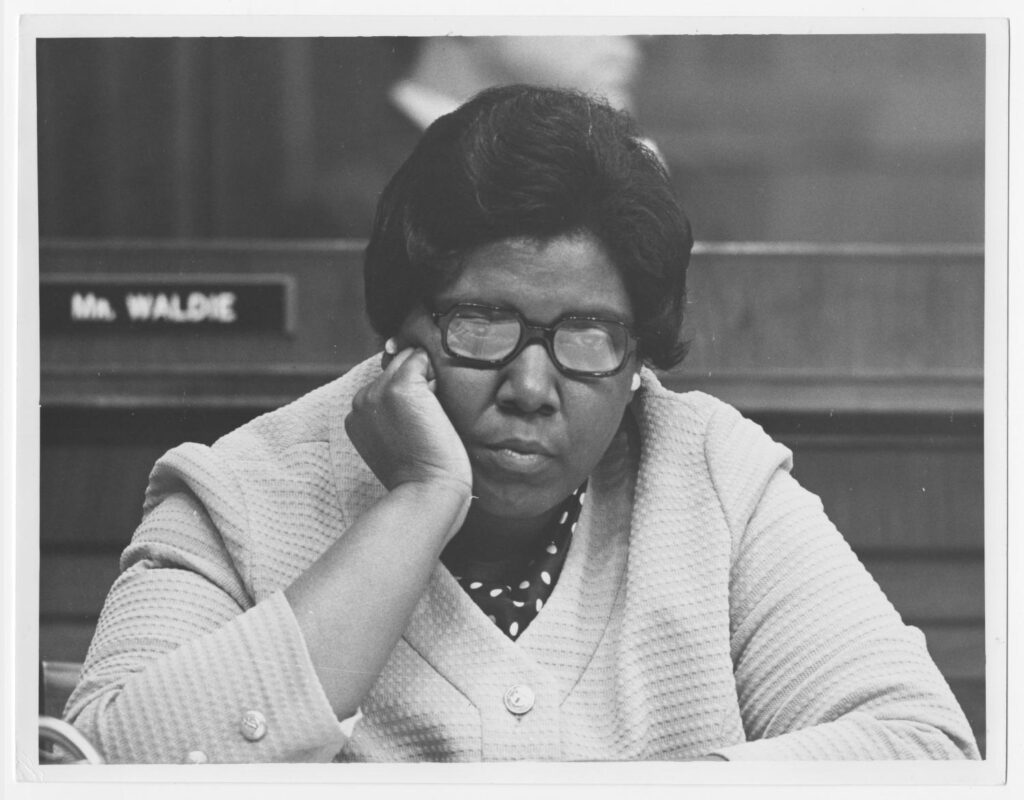
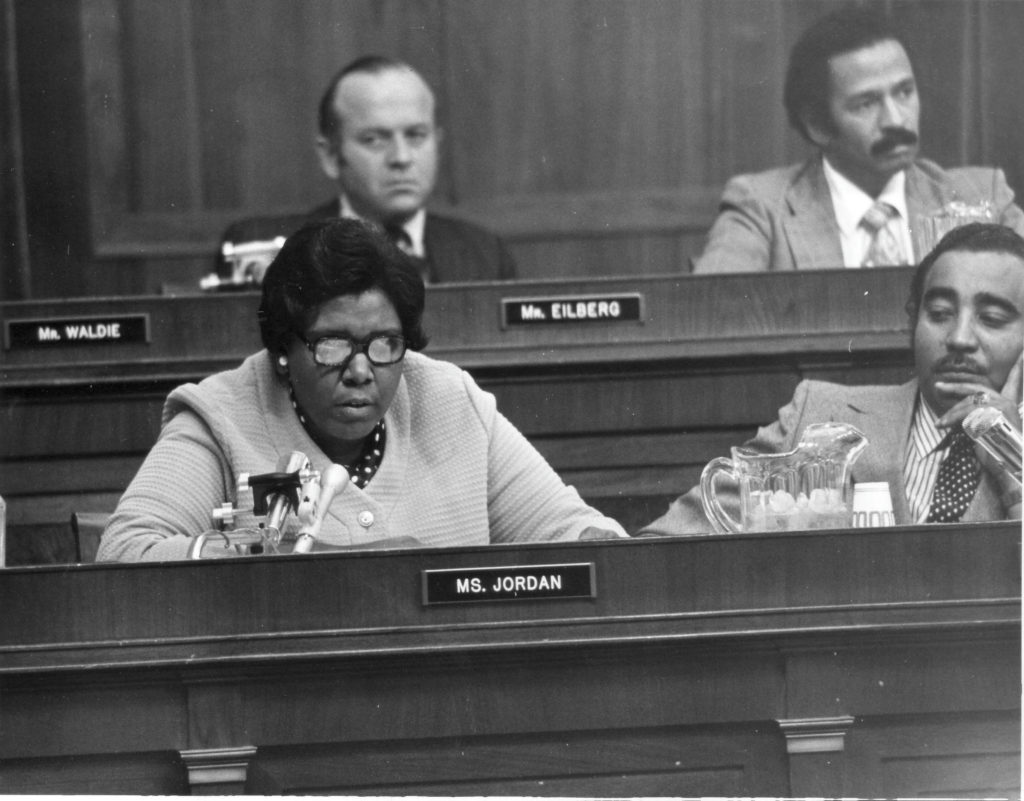
As the first Black woman elected to Congress from a Southern state, Congresswoman Barbara Jordan’s (D-TX) entry into the U.S. House of Representatives represented a historic breakthrough in American politics. It was her appointment to the House Judiciary Committee during her freshman term, however, that positioned Rep. Jordan as a powerful defender of the Constitution. Speaking before the committee as it deliberated whether to recommend articles of impeachment against President Richard Nixon, Rep. Jordan presented a clear and compelling interpretation of the Constitution for a nation struggling with questions about presidential power and accountability.
By mid-1974, the Watergate scandal had shaken public trust in the presidency and polarized the nation. Across the country, millions of Americans watched the televised impeachment hearings as the Judiciary Committee heard witnesses and debated how to proceed. In her opening remarks on July 25, 1974, Rep. Jordan, a lawyer by training, chose to frame impeachment not as a partisan process, but as a solemn duty embedded in the system of checks and balances designed by the nation’s founders. Drawing on the Constitution, the Federalist Papers, and other historical sources, she compared Nixon’s conduct against the founders’ own understanding of impeachable offenses. Rep. Jordan implied that failing to recommend impeachment would be a failure to uphold the Constitution. “If the impeachment provision in the Constitution of the United States will not reach the offenses charged here,” she declared, “then perhaps that eighteenth-century Constitution should be abandoned to a twentieth-century paper shredder.”
Rep. Jordan presented the Constitution as a living document, one capable of meeting threats like Watergate and correcting its own failures. She reminded those listening that when the document was completed in 1787, she had not been included in its opening words, “We, the people.” Yet, she explained, “through the process of amendment, interpretation, and court decision, I have finally been included in ‘We, the people.’” Now she stood not only as someone the Constitution protected, but as one charged with defending it as a member of Congress.
Rep. Jordan’s speech played a crucial role in galvanizing support for impeachment among committee members and in shaping public opinion during the final stages of the Watergate crisis. The Judiciary Committee ultimately approved three articles of impeachment, and President Nixon resigned shortly afterward. Rep. Jordan’s principled clarity offered reassurance that the system could still correct itself. In defending the Constitution at that moment of crisis, Rep. Jordan joined the tradition of African American members of Congress who have summoned the nation back to its founding charter in moments of constitutional strain.
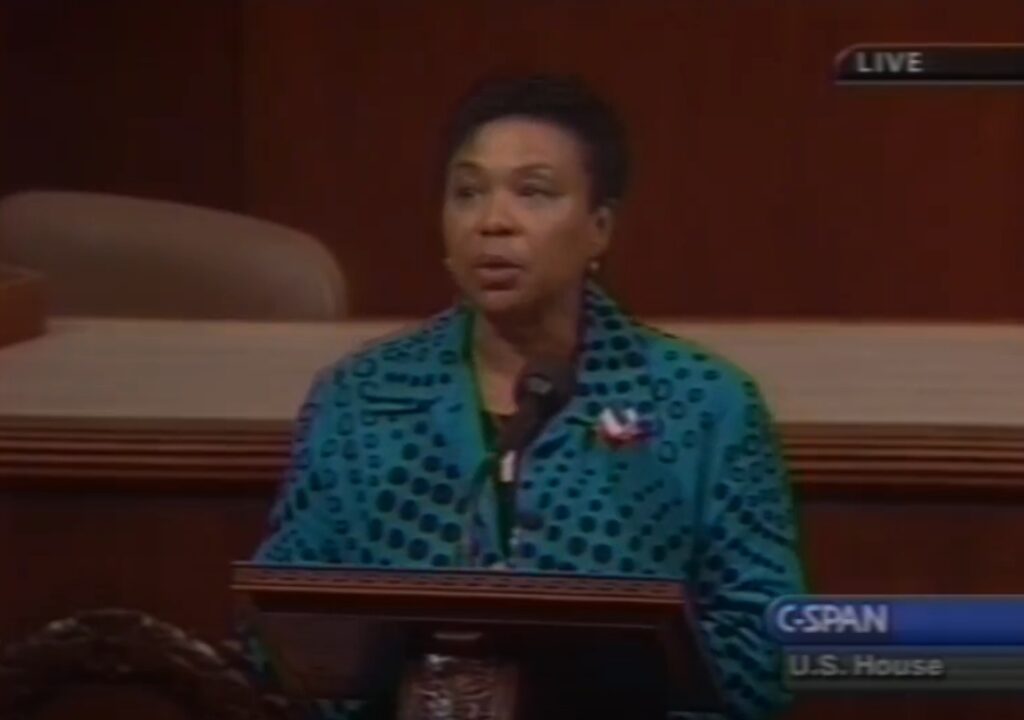
C-SPAN
Opening Statement to the House Judiciary Committee, Proceedings on the Impeachment of Richard Nixon
Representative Barbara Jordan (D-TX)
July 25, 1974
U.S. House Judiciary Committee Room, Rayburn House Office Building, United States Capitol, Washington, DC
Transcript from U.S. House. Committee on the Judiciary. Debate on Articles of Impeachment July 24-30, 1974. (statement of Barbara Jordan, p. 110-113).
Mr. Chairman, I join my colleague Mr. [Charles] Rangel in thanking you for giving the junior members of this committee the glorious opportunity of sharing the pain of this inquiry. Mr. Chairman, you are a strong man, and it has not been easy, but we have tried as best we can to give you as much assistance as possible.
Earlier today, we heard the beginning of the Preamble to the Constitution of the United States: “We, the people.” It’s a very eloquent beginning. But when that document was completed, on the seventeenth of September in 1787, I was not included in that “We, the people.” I felt somehow, for many years, that George Washington and Alexander Hamilton just left me out by mistake. But through the process of amendment, interpretation, and court decision, I have finally been included in “We, the people.”
Today I am an inquisitor. An hyperbole would not be fictional and would not overstate the solemness that I feel right now. My faith in the Constitution is whole; it is complete; it is total. And I am not going to sit here and be an idle spectator to the diminution, the subversion, the destruction of the Constitution.
“Who can so properly be the inquisitors for the nation as the representatives of the nation themselves?” The subjects of its jurisdiction are those offenses which proceed from the misconduct of public men. And that’s what we’re talking about. In other words, from the abuse or violation of some public trust.
It is wrong, I suggest, it is a misreading of the Constitution for any member here to assert that for a member to vote for an article of impeachment means that that member must be convinced that the President should be removed from office. The Constitution doesn’t say that. The powers relating to impeachment are an essential check in the hands of the body of the Legislature against and upon the encroachments of the Executive. The division between the two branches of the Legislature, the House and the Senate, assigning to the one the right to accuse and to the other the right to judge, the Framers of this Constitution were very astute. They did not make the accusers and the judgers—and the judges the same person.
We know the nature of impeachment. We’ve been talking about it awhile now. It is chiefly designed for the President and his high ministers to somehow be called into account. It is designed to “bridle” the Executive if he engages in excesses. “It is designed as a method of national inquest into the conduct of public men.” The Framers confided in the Congress the power, if need be, to remove the President in order to strike a delicate balance between a President swollen with power and grown tyrannical, and preservation of the independence of the Executive.
The nature of impeachment: a narrowly channeled exception to the separation-of-powers maxim; the Federal Convention of 1787 said that. It limited impeachment to high crimes and misdemeanors and discounted and opposed the term “maladministration.” “It is to be used only for great misdemeanors,” so it was said in the North Carolina ratification convention. And in the Virginia ratification convention, “We do not trust our liberty to a particular branch. We need one branch to check the other.” “No one need be afraid,”—the North Carolina ratification convention—“No one need be afraid that officers who commit oppression will pass with immunity.” “Prosecutions of impeachments will seldom fail to agitate the passions of the whole community,” said Hamilton in the Federalist Papers, number 65. “We divide into parties, more or less friendly or inimical to the accused.” I do not mean political parties in that sense.
The drawing of political lines goes to the motivation behind impeachment, but impeachment must proceed within the confines of the constitutional term “high crime and misdemeanors.”
Of the impeachment process, it was Woodrow Wilson who said that “Nothing short of the grossest offenses against the plain law of the land will suffice to give them speed and effectiveness. Indignation so great as to overgrow party interest may secure a conviction, but nothing else can.“
Common sense would be revolted if we engaged upon this process for petty reasons. Congress has a lot to do: appropriations, tax reform, health insurance, campaign finance reform, housing, environmental protection, energy sufficiency, mass transportation. Pettiness cannot be allowed to stand in the face of such overwhelming problems. So today we are not being petty. We are trying to be big because the task we have before us is a big one.
This morning in a discussion of the evidence, we were told that the evidence which purports to support the allegations of misuse of the CIA by the President is thin. We’re told that that evidence is insufficient. What that recital of the evidence this morning did not include is what the President did know on June the 23rd, 1972. The President did know that it was Republican money, that it was money from the Committee for the Re-Election of the President, which was found in the possession of one of the burglars arrested on June the 17th.
What the President did know on the 23rd of June was the prior activities of E. Howard Hunt, which included his participation in the break-in of Daniel Ellsberg’s psychiatrist, which included Howard Hunt’s participation in the Dita Beard ITT affair, which included Howard Hunt’s fabrication of cables designed to discredit the Kennedy Administration.
We were further cautioned today that perhaps these proceedings ought to be delayed because certainly there would be new evidence forthcoming from the President of the United States. There has not even been an obfuscated indication that this committee would receive any additional materials from the President. The committee subpoena is outstanding, and if the President wants to supply that material, the committee sits here.
The fact is that on yesterday, the American people waited with great anxiety for eight hours, not knowing whether their President would obey an order of the Supreme Court of the United States.
At this point, I would like to juxtapose a few of the impeachment criteria with some of the actions the President has engaged in.
Impeachment criteria: James Madison, from the Virginia ratification convention: “If the President be connected in any suspicious manner with any person and there be grounds to believe that he will shelter him, he may be impeached.”
We have heard time and time again that the evidence reflects the payment to defendants of money. The President had knowledge that these funds were being paid and these were funds collected for the 1972 Presidential campaign.
We know that the President met with Mr. Henry Petersen twenty-seven times to discuss matters related to Watergate and immediately thereafter met with the very persons who were implicated in the information Mr. Petersen was receiving. The words are: “If the President is connected in any suspicious manner with any person and there be grounds to believe that he will shelter that person, he may be impeached.”
Justice Story: “Impeachment” is attended—“is intended for occasional and extraordinary cases where a superior power acting for the whole people is put into operation to protect their rights and rescue their liberties from violations.”
We know about the Huston Plan. We know about the break-in of the psychiatrist’s office. We know that there was absolute, complete direction on September 3rd, when the President indicated that a surreptitious entry had been made in Dr. Fielding’s office, after having met with Mr. Ehrlichman and Mr. Young.
“Protect their rights.” “Rescue their liberties from violation.”
The Carolina ratification convention impeachment criteria: those are impeachable “who behave amiss or betray their public trust.”
Beginning shortly after the Watergate break-in and continuing to the present time, the President has engaged in a series of public statements and actions designed to thwart the lawful investigation by government prosecutors. Moreover, the President has made public announcements and assertions bearing on the Watergate case, which the evidence will show he knew to be false.
These assertions, false assertions, impeachable, those who misbehave. Those who “behave amiss or betray the public trust.”
James Madison, again, at the Constitutional Convention: “A President is impeachable if he attempts to subvert the Constitution.”
The Constitution charges the President with the task of taking care that the laws be faithfully executed. And yet the President has counseled his aides to commit perjury, willfully disregard the secrecy of grand jury proceedings, conceal surreptitious entry, attempt to compromise a federal judge while publicly displaying his cooperation with the processes of criminal justice.
“A President is impeachable if he attempts to subvert the Constitution.”
If the impeachment provision in the Constitution of the United States will not reach the offenses charged here, then perhaps that eighteenth-century Constitution should be abandoned to a twentieth-century paper shredder. Has the President committed offenses, and planned, and directed, and acquiesced in a course of conduct which the Constitution will not tolerate? That’s the question. We know that. We know the question. We should now forthwith proceed to answer the question. It is reason, and not passion, which must guide our deliberations, guide our debate, and guide our decision.
I yield back the balance of my time.
For a listing of materials published about Watergate in the Congressional Record, including debates and proceedings from the impeachment inquiry, see the Library of Congress research guide to the impeachment of Richard Nixon.
For more information about Watergate, including the people and events Rep. Jordan mentions in her speech, visit the Ford Presidential Library and Museum’s online Watergate exhibit.
Rep. Peter Rodino (D-NJ) served as chairman of the House Committee on the Judiciary during the impeachment hearings of President Richard M. Nixon.
Though not junior members like Rep. Jordan, Reps. Charles Rangel (D-NY) and John Conyers (D-MI) served as fellow African American members of the House Committee on the Judiciary during the impeachment hearings. Rep. Rangel and Rep. Conyers were also founding members of the Congressional Black Caucus.
In 1974, the House Committee on the Judiciary held hearings to investigate if grounds for the impeachment of President Richard Nixon existed. Portions of the debate, including Rep. Jordan’s opening remarks, were televised. The Committee ultimately adopted three articles of impeachment.
For a guide to government records related to Nixon impeachment, visit the Library of Congress’ Richard Nixon Federal Impeachment research guide.
George Washington served as president of the 1787 Constitutional Convention and later as the first president of the United States under the new Constitution drafted at the convention.
Alexander Hamilton was a delegate at the Constitutional Convention of 1787 and authored many installments of The Federalist Papers which helped persuade ratification of the new constitution by the states. Rep. Jordan quoted extensively from Hamilton’s installments of The Federalist Papers in her remarks.
Alexander Hamilton, The Federalist No. 65, 7 March 1788.
The Constitution contains a number of provisions relevant to the impeachment of federal officials. Among them, Article I, Section 2, Clause 5 grants the sole power of impeachment to the House of Representatives while Article I, Section 3, Clause 6 assigns the Senate the sole responsibility to try impeachments.
Alexander Hamilton, The Federalist No. 65, 7 March 1788.
Rep. Jordan quotes Woodrow Wilson’s Congressional Government: A Study in American Politics originally published in 1885 while studying at Johns Hopkins. Wilson later served as President of the United States from 1913-1921.
Justice Joseph Story served in the U.S. House of Representatives and was later appointed by President James Madison as an Associate Justice of the Supreme Court of the United States. He published several commentaries on the Constitution and other works. This quote comes from Commentaries on the Constitution of the United States (1833) page 221-222.
This quote is often credited to James Madison, but it is likely from George Mason of Virginia, a different delegate to the Constitutional Convention, during debate on September 8, 1787. More information on delegate debate over the list of impeachable acts.